The Sub-Meter Trap: Why Smart Tenants Are Asking Tougher Questions About Energy
Published:
Read Time: 6 mins
By Robert Webb, Bureau Operations Manager, TEAM Energy
Most businesses wouldn't sign off an invoice they couldn't verify.
Yet many tenants routinely pay energy bills without fully understanding how costs have been calculated or how much energy they have actually consumed.
As energy costs, carbon reporting and sustainability expectations continue to move up the corporate agenda, access to accurate consumption data is becoming increasingly important. In multi-occupancy buildings, however, sub-metering arrangements can leave occupiers with limited visibility of the information they need to manage costs and performance effectively.
Paying the bill without seeing the data
Most organisations would never accept an invoice for raw materials, logistics or telecommunications without understanding what they are being charged for. Yet energy is often treated differently.
Many tenants receive a recharge invoice each month or quarter with little visibility of the underlying consumption data. Some receive summary figures but no access to meter readings, while others struggle to understand how shared costs have been apportioned.
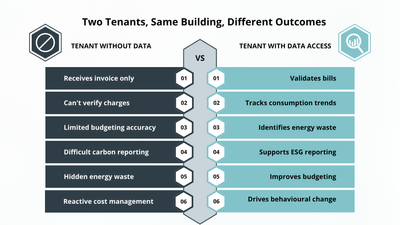
Without accurate, timely energy data, it becomes difficult to determine whether consumption is increasing, charges reflect actual usage, or efficiency initiatives are delivering results. Limited visibility also hinders performance benchmarking, cost control and sustainability reporting.
In effect, organisations are paying for energy without the information needed to fully understand, manage or optimise it. Increasingly, that information is relied upon by finance directors, sustainability managers and business leaders alike.
The cost of operating blind
At a time when businesses are working hard to improve efficiency and control costs, energy data has become a valuable management tool.
Consumption data helps organisations identify waste, forecast budgets, support investment decisions and measure performance. It is also increasingly important for carbon accounting, sustainability reporting and ESG disclosures. Organisations often rely on specialist energy bureau services to consolidate, validate and analyse utility data from across their estates.
When that data is incomplete, delayed or unavailable, informed decision-making becomes far more difficult. Two occupiers may spend the same amount on energy, but only one has the visibility to understand where it is being used, whether costs are increasing and how improvements can be made.
The other is effectively operating blind.
Data that changes behaviour, not just bills
There is also a behavioural dimension to consider. Meaningful energy data does more than validate invoices or support reporting. It helps people understand how their day-to-day decisions affect consumption, cost and carbon.
When occupiers can see clear patterns in their energy use, they are better placed to question what is happening within their space. Unexpected overnight consumption, weekend spikes, inefficient heating and cooling schedules, or equipment being left on unnecessarily all become easier to identify and address.
This is where data becomes educational. It turns energy from an abstract overhead into something employees, facilities teams and business leaders can influence. By making consumption visible and understandable, organisations can encourage better habits, support operational changes and give people ownership of the actions that reduce waste.
In that sense, access to good energy data is not only a question of transparency. It is also a practical tool for changing behaviour and improving performance over time.
It's not just electricity
In many multi-occupied buildings, energy costs extend beyond electricity supplied directly to a tenant's space.
Heating, cooling, water and even waste management costs may be recovered through service charges or apportionment methodologies that are not always fully understood by occupiers.
Where infrastructure is shared, costs are often apportioned using floor area, occupancy levels or other agreed methodologies rather than actual consumption. While these arrangements are often necessary, they can make it difficult for tenants to understand what is driving costs and whether efficiency measures are delivering savings.
As more shared services are involved, transparent metering, clear allocation methodologies and access to supporting data become increasingly important.
Why this is becoming a bigger issue
Historically, the primary purpose of energy billing was cost recovery. Today, expectations are changing.
Businesses are being asked to provide increasingly detailed information about their environmental performance. Customers, investors, lenders and corporate reporting frameworks all place greater emphasis on understanding energy use and carbon emissions.
For occupiers with limited access to energy data, meeting these expectations can become significantly more difficult.
What was once an operational inconvenience is rapidly becoming a business risk.
Questions every tenant should ask before signing a lease
The good news is that many of these challenges can be addressed before a tenancy agreement is signed.
Energy arrangements deserve the same scrutiny as rent reviews and service charges.
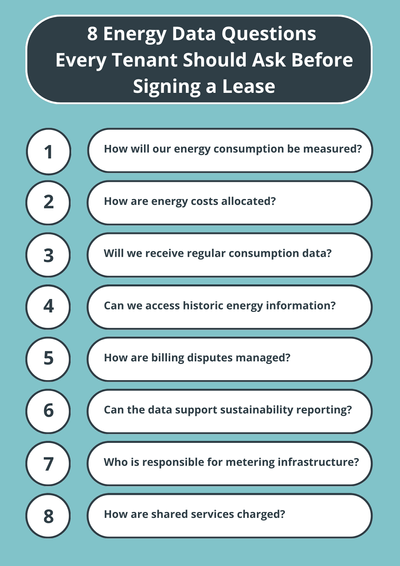
Key questions include:
How will our energy consumption be measured?
Understanding whether consumption is recorded through a dedicated meter or shared sub-meter is essential. Businesses seeking greater clarity on sub-metering arrangements can benefit from reviewing practical guidance on tenant energy data and sub-metering before entering lease negotiations.
This is particularly important in buildings served by communal heating or cooling systems, where heat network arrangements may operate separately from traditional electricity supplies. Occupiers should understand how heat consumption is measured, billed and evidenced.
How are energy costs allocated?
Tenants should understand exactly how utility costs are apportioned and whether any estimates, assumptions or shared-area calculations are involved.
Will we have access to our consumption data?
Receiving an invoice is not the same as receiving meaningful energy information. Tenants should establish what data will be provided, how frequently it will be available and whether it can be used for internal reporting.
Can we access historic consumption information?
Previous energy performance can provide valuable insight into likely operating costs and future efficiency opportunities.
How are billing errors resolved?
Every billing process should include a clear mechanism for investigating discrepancies and validating charges.
Can the data support sustainability reporting?
As reporting requirements continue to evolve, businesses should ensure they can access the information needed to support carbon and sustainability disclosures.
Who is responsible for meter accuracy and maintenance?
Reliable data depends on reliable infrastructure. Responsibilities should be clearly defined from the outset.
How are shared services and common areas charged?
Where heating, cooling, lighting, water or other building services are shared, tenants should understand the methodology used to apportion costs and whether those calculations can be independently verified.
Energy data is becoming a lease negotiation issue
The commercial property sector is undergoing a broader shift in expectations.
Just as EPC ratings have become an increasingly important consideration for occupiers, visibility of energy consumption data is likely to become a key factor in future leasing decisions.
Businesses are recognising that the ability to manage energy costs depends on the ability to measure them accurately. Without transparent, accessible and auditable data, even the most ambitious efficiency or sustainability strategies will struggle to deliver meaningful results.
Looking beyond the invoice
The biggest risk facing many tenants is not necessarily rising energy prices.
It is paying for energy they cannot properly see, understand or manage.
Before signing a lease, businesses should be asking more than how much a space will cost. They should also be asking what information they will receive to help control those costs throughout the life of the tenancy.
Because in today's business environment, access to good energy data is no longer a technical detail. It is a commercial advantage.
Ends
Editors notes
About TEAM
TEAM is an energy and sustainability consultancy. It helps organisations with large energy estates reduce consumption and carbon emissions to save money and meet commercial and compliance targets on their journey to net zero.
Founded in 1985, it has a long history of helping customers navigate changing definitions and certification standards. TEAM Energy is an Employee Ownership Trust (EOT), with employees having a direct stake in its customers’ success.
About Rob Webb
Rob oversees the day-to-day operations of TEAM Energy's Tenant Billing, Energy Bureau and Power Management outsourcing department, ensuring the most accurate and timely utility bill validation and energy data management service. His focus on innovation and customer-centric strategies ensures the overall efficiency and effectiveness of TEAM's Energy Bureau.