Renewable electricity was the easy part. What's next for Scope 2 emissions?
Published:
Read Time: 5 mins
By Graham Paul, Service Delivery Director, TEAM Energy
For much of the past decade, Scope 2 emissions have been the success story of corporate decarbonisation.
Businesses switched to renewable electricity contracts, signed power purchase agreements and purchased renewable energy certificates. Combined with grid decarbonisation and energy efficiency improvements, these actions helped many organisations cut reported emissions at a pace that would have been difficult elsewhere in their carbon footprint.
In the UK, renewable technologies accounted for a record 52.5% of electricity generation in 2025, with low-carbon sources accounting for 64.8%.
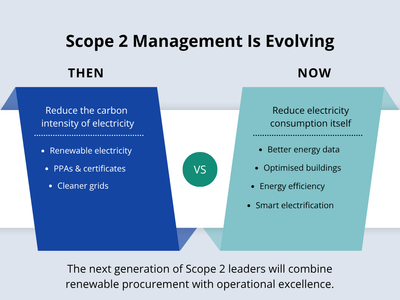
But as organisations approach near-zero market-based Scope 2 emissions, the challenge is no longer switching to renewable electricity, it's finding new ways to reduce consumption and drive further progress.
The end of easy wins
The appeal of Scope 2 has always been clear.
Unlike Scope 3 emissions, which depend on complex supply chains and stakeholder engagement, Scope 2 sits largely within an organisation's control. For many businesses, emissions from purchased electricity, heating and cooling represent a significant source of operational emissions and cost. The GHG Protocol notes that energy generation accounts for almost 40% of global greenhouse gas emissions, with commercial and industrial organisations responsible for consuming around half of that energy.
Renewable electricity contracts have undoubtedly accelerated progress. They have helped stimulate demand for renewable generation and provided organisations with a practical route to reducing reported emissions.
Low emissions do not always mean low consumption
This is where the conversation around Scope 2 becomes more interesting.
An organisation can report very low market-based Scope 2 emissions while still consuming large amounts of electricity. From a carbon accounting perspective, that may look like success. From an energy management perspective, however, it can highlight significant untapped opportunities to reduce demand.
This distinction is becoming increasingly important as investors, customers and regulators place greater scrutiny on the credibility of climate claims and the real-world impact of decarbonisation strategies. At the same time, debate continues around the future evolution of Scope 2 accounting, and the role renewable electricity procurement should play within corporate reporting frameworks.
Renewable electricity remains a vital part of the transition, but there is growing recognition that procurement alone cannot replace genuine reductions in energy consumption. The organisations leading the next phase of decarbonisation will be those that can demonstrate both.
The electrification paradox
At the same time, many organisations are increasing their dependence on electricity.
Vehicle fleets are being electrified. Gas heating systems are being replaced with heat pumps. Industrial processes are shifting away from fossil fuels.
These are positive developments and, in many cases, essential for achieving net-zero ambitions. But they also create a paradox.
As organisations decarbonise, electricity demand is likely to grow. The International Energy Agency identifies electrification of heating systems and building energy use as a critical part of the transition, while highlighting that buildings account for around 30% of global energy demand.
The businesses that succeed will not simply be those that purchase more renewable electricity. They will be those that understand how electrification affects energy demand, infrastructure capacity, peak load management and operational efficiency.
Why energy efficiency is making a comeback
For years, energy efficiency has often taken a back seat to more visible sustainability initiatives.
As procurement-led Scope 2 reductions begin to plateau, energy efficiency is re-emerging as one of the most effective ways to drive further progress. Unlike renewable electricity procurement alone, energy efficiency reduces electricity consumption and ordinarily lowers location-based Scope 2 emissions. It can also reduce market-based Scope 2 emissions where the electricity consumed carries a non-zero market-based emission factor. Where qualifying contractual instruments already result in zero or near-zero market-based emissions, efficiency improvements may not reduce the reported market-based figure further, but they will still lower consumption, costs and exposure to future energy demand.
The opportunities are well known: optimising HVAC systems, eliminating unnecessary baseload consumption, improving building controls, using monitoring and targeting to identify inefficiencies, investing in smart technologies and automation, and upgrading building fabric and equipment.
Yet many organisations have only scratched the surface of what is possible when energy performance is treated as a strategic business priority rather than simply a facilities management issue.
The cleanest and cheapest unit of energy remains the one that is never used.
Data will define the next generation of leaders
The next frontier of Scope 2 management may not be procurement. It may be data.
Many organisations can report annual electricity consumption, but far fewer can explain where energy is being wasted, why demand varies between sites or what operational changes would deliver the greatest reductions.
As electricity becomes increasingly central to net-zero strategies, businesses need a deeper understanding of how energy is consumed across their operations.
This requires better metering, better monitoring and better governance of energy data.
The organisations making the greatest progress over the next decade are likely to be those that move beyond annual reporting cycles and use energy data to drive continuous improvement.
A new phase of Scope 2 management
Renewable electricity contracts remain a vital part of corporate decarbonisation strategies, but for many organisations they are no longer the destination, they're the starting point.
As the easiest Scope 2 reductions have been achieved, attention is shifting to energy efficiency, data-led decision-making, electrification planning and operational performance. For organisations already buying renewable electricity, the challenge is increasingly about identifying the remaining opportunities to reduce Scope 2 emissions.
The organisations that succeed in this next phase will not necessarily be those reporting the lowest Scope 2 figures. They will be the ones consuming less energy, using it more effectively and building resilience in a rapidly changing energy landscape.
After all, renewable technologies already account for more than half of the UK's electricity generation. The next challenge is not simply buying cleaner electricity but ensuring we need less of it in the first place.
Ends
Editors notes
About TEAM
TEAM is an energy and sustainability consultancy. It helps organisations with large energy estates reduce consumption and carbon emissions to save money and meet commercial and compliance targets on their journey to net zero.
Founded in 1985, it has a long history of helping customers navigate changing definitions and certification standards. TEAM Energy is an Employee Ownership Trust (EOT), with employees having a direct stake in its customers’ success.
About Graham Paul
Graham leads service delivery, sales and marketing to enhance customer experience and scale TEAM’s carbon and energy services with a data driven, outcomes focus.