Lawn damage on the rise: how to spot leatherjacket infestations – and treat them the organic way
Published:
Read Time: 4 mins
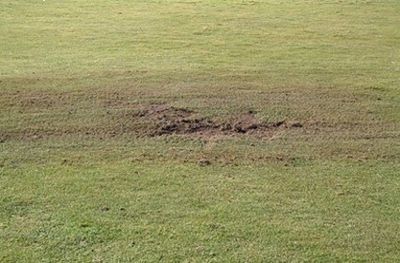
As autumn approaches and crane flies begin to emerge in large numbers, many UK homeowners are noticing troubling signs in their lawns: patches of dead grass, loose turf, and unexplained holes. The cause? Leatherjackets – the destructive larvae of crane flies, also commonly known as daddy long legs.
These grubs feast on grassroots, seedlings, and young plants, turning previously healthy lawns into patchy, brown mud pits. Even worse, their presence attracts birds, badgers, and foxes that dig up turf in search of a meal, causing further destruction.
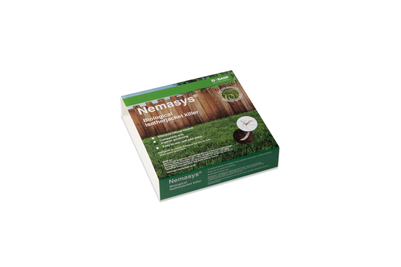
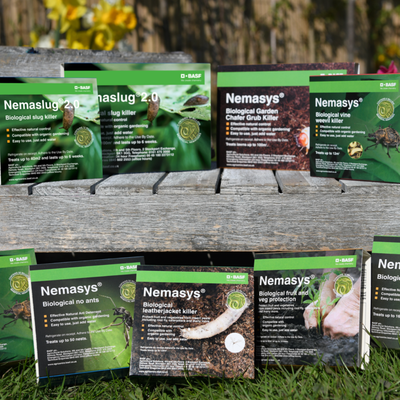
Fortunately, there is an effective and environmentally friendly solution. Read on to discover how Nemasys Biological Leatherjacket Killer can help protect lawns this season - and learn how to identify if your grass is at risk of infestation.
Why leatherjackets thrive in certain lawn conditions
Rather than just seasonal weather, it’s specific lawn conditions that allow leatherjackets to thrive. Understanding what makes grass more appealing to these pests is the first step in protecting it.
· Newly laid or young turf: Freshly grown grass has soft, tender roots that are more nutritious and easier for leatherjackets to feed on than older, established lawns.
· Consistently damp lawns: Leatherjackets thrive in moist environments. Poorly drained lawns or those that are frequently overwatered create the ideal conditions for eggs to hatch and larvae to survive.
· Undisturbed or lightly used lawns: Areas with soft, compacted soil and minimal foot traffic provide a safe haven for larvae to burrow undisturbed.
· Meadow or grassland soil: Many new build homes are constructed on former meadows or grassland – natural habitats for crane flies and their larvae – making new lawns particularly susceptible to infestation
Why new builds are at risk
Leatherjackets prefer freshly laid or recently grown turf, which is more tender and nutrient-rich than older, established grass. New build homes are particularly susceptible due to the combination of young lawns and their location as mentioned above – is often on old meadows or grassland, which are ideal environments for leatherjackets and craneflies.
Spotting a leatherjacket infestation
Early detection is key. Here’s how to identify a potential problem:
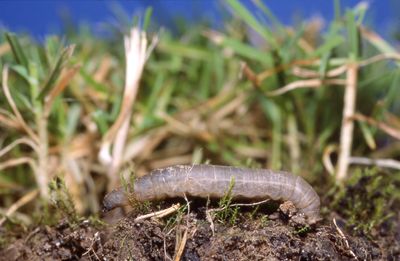
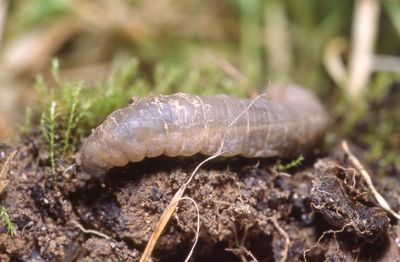
- What they look like: Leatherjackets are greyish-brown to black in colour, with tubular, legless bodies that can grow up to 3 cm long. They have no visible head or legs and resemble fat, wriggling worms.
- Signs of damage: Yellowing grass, dead patches, and loose turf are early warning signs. Holes in the lawn may indicate birds or animals digging for grubs.
- Testing your lawn: Drench a patch of grass with water and cover it overnight with a sheet of black plastic or tarpaulin. By morning, leatherjackets will rise to the surface and can be seen clearly. Alternatively, lift a small section of turf – if present, the grubs will be visible just below the soil surface.
A sustainable solution: Nemasys Biological Leatherjacket Killer
Since the withdrawal of chemical pesticides such as chlorpyrifos in 2016, biological control has become the most effective and environmentally responsible way to tackle leatherjackets. One of the leading options is Nemasys Biological Leatherjacket Killer.
This solution uses Steinernema feltiae, a species of beneficial nematode – microscopic worms that naturally target and kill leatherjackets. After entering the grub’s body through natural openings, the nematodes release bacteria that kill the pest from within. Once the pest population declines, nematodes naturally reduce in number, leaving no residue behind.
Why choose Nemasys beneficial nematodes?
- Compatible with organic gardening, nematodes don’t harm humans, pets, birds, bees, and other wildlife.
- Easy to apply - Simply mix the dried granules with water and apply to lawns using a watering can or sprayer. Best applied in the morning or evening to avoid strong sunlight.
- Apply when soil temperatures are above 10°C – spring and early autumn are ideal. Keep the treated area moist for two weeks post-application for best results.
- Long-lasting protection for up to six weeks, or for severe infestations, a second treatment after 2-4 weeks is recommended.
Nemasys Biological Leatherjacket Killer is available from various online retailers, with prices starting at £16.99. To find your nearest stockist or learn more about how nematodes work, visit: www.nemasysinfo.co.uk or watch the explainer video: https://youtu.be/JHNG1KSluh0
Ends
Editors notes
Nematodes are naturally occurring microscopic worms, already present in our soil. Beneficial nematodes attack and kill targeted garden pests. They are compatible with organic farming, easy to use and can even be kept in your fridge!
Research scientists have isolated the nematodes that kill specific garden pests including Slugs, Vine weevils, Leatherjackets, Caterpillars, Codling moth and much more.
BASF’s state of the art production facility in the UK produces billions of nematodes in a form that is easily applied by gardeners. Over 20,000 different species of nematodes have been classified, although some estimates put the total figure closer to one million! BASF has the largest specialist nematode production facility in the world, growing trillions of beneficial nematodes for use in their Nemasys range of pest control products.
BASF experts are available for interviews, features and expert comment on biological pest control management, and product is available for reviews, competitions and product trials.