The Scope 3 reporting trap: measuring more, changing less
Published:
Read Time: 5 mins
Scope 3 emissions have become central to the corporate carbon conversation.
Driven by investor expectations, customer requirements, net zero commitments and growing reporting obligations, organisations are investing significant time and resource into understanding emissions across their value chains. Supply chains are being mapped, procurement data analysed and suppliers engaged at a scale that would have been uncommon just a few years ago.
This is welcome progress. Organisations cannot manage emissions they cannot see.
However, as Scope 3 reporting becomes more established, an important question is emerging: are businesses becoming better at reporting emissions than reducing them?
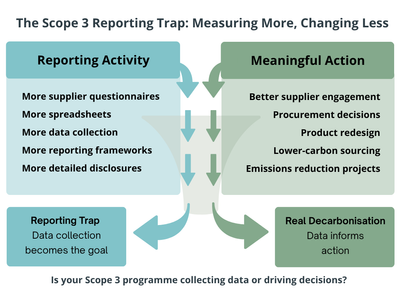
Too often, organisations devote substantial effort to collecting data that is disconnected from decision-making. The reporting process becomes the priority, while the commercial and operational changes needed to reduce emissions struggle to keep pace.
The risk is that businesses end up measuring more while changing less.
More data does not always mean better insight
For many organisations, estimating Scope 3 emissions is an essential starting point.
Spend-based calculations and industry-average emissions factors can help build an initial inventory, identify hotspots and establish a baseline where supplier-specific information is unavailable.
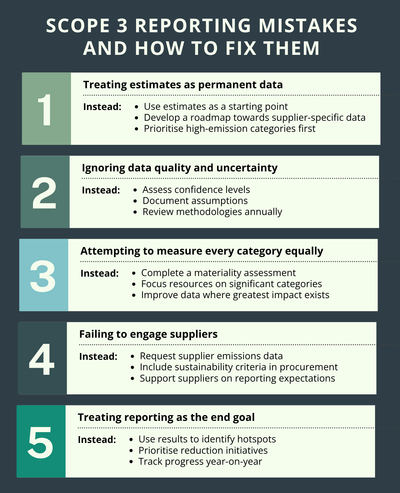
The challenge comes when these broad estimates become a permanent solution.
A carbon inventory may appear highly detailed while still relying on assumptions that reveal little about the performance of individual suppliers, products or materials. Two suppliers delivering the same product could have very different emissions profiles but appear almost identical in a spend-based assessment.
This becomes particularly problematic when organisations try to measure progress. Changes in emissions may reflect purchasing patterns, volumes or prices rather than genuine reductions.
As a result, businesses can produce increasingly sophisticated reports without gaining a much clearer understanding of where meaningful decarbonisation opportunities exist.
The objective should not be more data for its own sake. It should be better information where it matters most.
As reporting programmes mature, organisations should focus on improving data quality in significant emissions categories, especially where better information can support operational, procurement or investment decisions.
Reporting fatigue is becoming a strategic risk
The growth of Scope 3 disclosure is creating a substantial administrative burden.
Sustainability teams often spend months gathering information from suppliers, travel providers, logistics partners, procurement functions and finance systems. At the same time, many suppliers are responding to multiple customer requests for similar emissions information, often in different formats.
This can create reporting fatigue across the value chain.
Internal teams become focused on managing spreadsheets, questionnaires and reporting frameworks, while suppliers may begin to view carbon data requests as another compliance exercise. The result can be lower-quality responses, inconsistent data and reduced engagement.
More importantly, excessive reporting demands can divert attention away from activities that actually reduce emissions.
Organisations should therefore be selective about the information they request and clear about how it will be used. If a data point does not improve reporting accuracy, support compliance requirements or inform a business decision, its value should be questioned.
Transparency remains essential, but reporting should always serve a purpose beyond reporting itself.
Supplier questionnaires are not supplier engagement
One of the most common misconceptions in Scope 3 reporting is that supplier engagement simply means collecting supplier data.
In reality, meaningful engagement goes much further.
Suppliers vary considerably in their carbon maturity. Some have robust emissions data and reduction targets. Others are only beginning to measure their footprint. Asking every supplier for the same information is unlikely to deliver the most useful results.
Instead, organisations should focus attention on suppliers associated with their most significant emissions and where collaboration is most likely to drive change.
That may involve helping suppliers improve measurement capabilities, discussing lower-carbon alternatives or identifying opportunities to reduce emissions across the supply chain.
Procurement teams also have a critical role to play. If carbon performance is not considered during supplier selection, contract renewal or purchasing decisions, reporting remains disconnected from the commercial choices that influence emissions.
The goal should not be to collect more supplier data. It should be to create stronger supplier relationships that support emissions reduction. The goal should not be to collect more supplier data. It should be to create stronger supplier relationships that support emissions reduction. As we explore in TEAM's guide to five common Scope 3 reporting mistakes and how to avoid them, meaningful supplier engagement is often the difference between producing emissions data and delivering emissions reductions.
Focus precision where it can influence decisions
Not every Scope 3 category deserves the same level of attention.
A manufacturer, property owner, retailer and professional services business will all have different emissions profiles and different opportunities to influence change within their value chains.
Attempting to achieve the same level of precision across every category can spread resources too thinly and delay action.
Organisations should focus their greatest effort on significant emissions sources and on data that informs decision-making. For less material categories, high-level estimates may be entirely appropriate.
This approach allows organisations to improve data quality strategically rather than pursuing perfect accuracy everywhere at once.
The aim is not to create the largest inventory possible. It is to create an inventory that supports better decisions.
Reporting must lead to action
Ultimately, the value of Scope 3 reporting lies in what organisations do with the information they collect.
A completed inventory may satisfy reporting requirements, but it does not automatically reduce emissions. Real progress comes when carbon data influences procurement strategies, supplier relationships, product design, investment decisions and operational priorities.
For every major emissions source, organisations should be asking practical questions:
- What is driving these emissions?
- How reliable is the underlying data?
- Which teams can influence the outcome?
- What reduction opportunities are available?
- What additional information would support better decisions?
If reporting cannot help answering these questions, collecting more data may offer limited value.
The organisations likely to make the greatest progress will not necessarily be those producing the most detailed disclosures. They will be those that use carbon data to inform decisions, prioritise meaningful supplier engagement and focus effort where it can have the greatest impact.
Because the purpose of Scope 3 reporting is not simply to describe the value chain.
It is to change it.
Ends
Editors notes
About TEAM
TEAM is an energy and sustainability consultancy. It helps organisations with large energy estates reduce consumption and carbon emissions to save money and meet commercial and compliance targets on their journey to net zero.
Founded in 1985, it has a long history of helping customers navigate changing definitions and certification standards. TEAM Energy is an Employee Ownership Trust (EOT), with employees having a direct stake in its customers’ success.
About Graham Paul
Graham leads service delivery, sales and marketing to enhance customer experience and scale TEAM’s carbon and energy services with a data driven, outcomes focus.