October Press Statement - Wood-burning stoves: The majority of domestic combustion emissions are caused by poor burning habits on outdated appliances
Published:
Read Time: 5 mins
Please find below comment from Head of Technical Services at Cleaner Safer Group, Calvin May, addressing the misconceptions and misinformation around woodburning and the wider solid fuel industry. We thought this could be of interest to keep on file should you be writing future features on wood-burning or biomass appliances over the coming weeks.
Cleaner Safer Group is an independent not-for-profit organisation dedicated to creating a cleaner, safer and more sustainable environment. The Group, which includes HETAS and Woodsure, provides insight to government departments including Defra, DESNZ and MHCLG, leads the way in training, education, certification and testing across the solid fuel, wood and biomass heating industries.
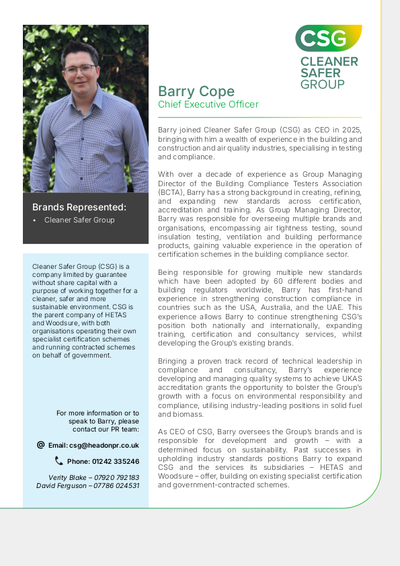
Calvin joined the Group over 15 years ago and was appointed Head of Technical Services in 2022. He is responsible for leading policy and strategy for best practice standards for the installation and commissioning of solid fuel equipment and services. Please find his full bio below.
For interviews, please contact Verity Blake/David Ferguson/Olivia Furniss on CSG@headonpr.co.uk // 0792 0792 183 // 07786 024 531
Wood-burning stoves: The majority of domestic combustion emissions are caused by poor burning habits on outdated appliances
· High-quality fuel burnt on a modern wood-burning stove accounts for less than 0.3% of the UK’s total PM2.5 emissions.
· The majority of domestic combustion emissions are caused by poor burning habits on outdated appliances.
· We must focus on educating stove users to burn responsibly, for a cleaner, safer and more sustainable environment.
· Every aspect of a wood-burning stove is scrutinised to adhere to regulations, legislation, and best practices.
“There are a lot of conflicting messages and statistics around wood burning at home but there shouldn’t be. Government has not said it intends to ban domestic burning and recently announced that wood burning stoves would be permitted as a secondary heating source in new-build homes under the Future Homes Standard. This has also been echoed in other parts of the UK with the Scottish Government u-turning on its ban on wood-burning stoves in new build homes last year.
“Research shows that banning burning will impact many vulnerable groups, with 15% or 4.4 million households in Great Britain off grid. The National Atmospheric Emissions Inventory (NAEI) and supporting documents also show that high-quality fuel burnt on a modern stove accounts for less than 0.3% of the UK’s total PM2.5 emissions.
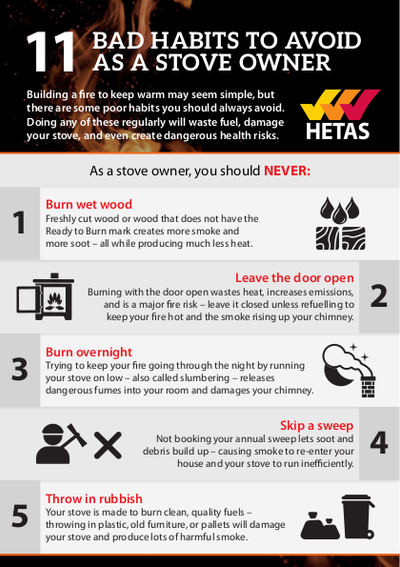
“The majority of domestic combustion emissions are caused by poor burning habits, where users are burning unseasoned wood on old, inefficient appliances that don’t meet Ecodesign standards.
“When used correctly and with the appropriate fuels and maintenance routine, a solid fuel stove can be an excellent, efficient and cleaner source of heat for the home.
“It’s important that we stay focused on working together to educate stove users to burn responsibly, minimise emissions, and continue research into best practise, for a cleaner, safer environment.
“Organisations like HETAS and Woodsure, together with manufacturers, registered retailers, trade professionals, and fuel suppliers work continuously with Government to limit the worst burning practices while educating stove users on responsible ownership, maintenance, and the use of higher-quality, Ready to Burn fuels to reduce emissions.
“Legislation also exists to prevent the poorest, least efficient and most polluting ways of heating a home with a solid fuel appliance. These include using Defra-regulated Ready to Burn certified dry firewood for a cleaner, more efficient burn; a ban on traditional house coal in England; and Smoke Control Areas (SCAs) where Defra-exempt and Cleaner Choice appliances can be installed, to limit which fuels and appliances can be used by homeowners. Local authorities also have legislative powers in SCAs to fine those burning irresponsibly.
“Every aspect of a wood burning stove – from manufacturing and installation by a competent professional, to fuelling and maintenance – is held under scrutiny to ensure regulations, legislation, and best practices are followed for a cleaner, safer environment.”
HGV comparison
“The PM2.5 emissions comparison with HGVs originates from a 2021 report by the European Environmental Bureau (EEB), but the raw figures don’t tell the whole story. In practice, it’s difficult to make a like-for-like comparison because wood-burning stoves and heavy goods vehicles are used in very different ways.
“For instance, many comparisons look at PM2.5 output from an idling HGV versus a standard 5 kW Ecodesign stove, running at full capacity. In reality stove users typically reduce the burn once a comfortable room temperature is reached, while an idling HGV produces emissions without generating any “useful” energy. A stove, by contrast, provides essential heat that replaces other forms of domestic heating.
“These comparisons also overlook variable emissions from HGVs caused by stop-start driving, driver behaviour and brake dust. Official Government statistics recognise that most PM emissions from road transport derive from non-exhaust sources, yet these comparisons focus on exhaust emissions alone. This discounts a major portion of emissions from HGVs, especially due to their weight, oversimplifying a complex problem. These comparisons also omit how the latest government data shows that domestic combustion PM emissions have fallen below road transport emissions.
“Furthermore, HGVs run on fossil fuels, whereas wood-burning stoves use a fuel source that can be sourced sustainably, supporting local economies and increasing the economic incentives of woodland management across the UK.”
- ENDS
Author bio
Calvin May, Head of Technical Services at Cleaner Safer Group
Calvin joined Cleaner Safer Group over 15 years ago and was appointed Head of Technical Services in 2022. He is responsible for leading policy and strategy for best practice standards for the installation and commissioning of solid fuel equipment and services.
He is also Chairman of BSI solid fuel technical committee RHE/28, the standard for residential solid fuel burning appliances, and an expert representative on current European residential standards committee.
Calvin is committed to raising awareness of the impacts and improvements in environmental responsible burning of solid based fuels within the sector.
---
Ends
Editors notes
Cleaner Safer Group is a company limited by guarantee without share capital, and has a purpose of working together for a cleaner, safer, more sustainable environment.
The group is made up of HETAS and Woodsure, with both organisations specialising in certification schemes in the solid fuel and biomass sector.
Both organisations operate their own specialist certification schemes and run contracted schemes on behalf of government, including the Ready to Burn certification schemes for wood and manufactured solid fuels, the Biomass Suppliers List and smoke control exemption for appliances.