Newly Highlighted Medieval Witch Marks Add to Langley Castle’s Appeal
Published:
Read Time: 3 mins
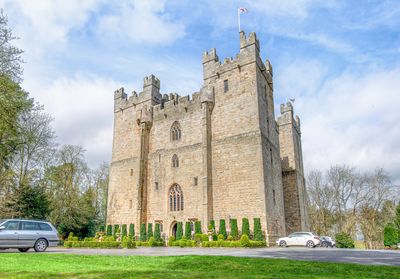
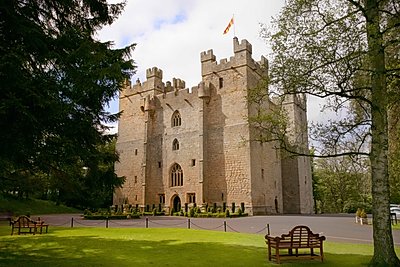
The authentic medieval nature of Langley Castle Hotel, near Hexham, has been unexpectedly amplified following a stay enjoyed by a folklore influencer, who discovered witch marks in a castle corridor and room.
Lauren Moss, known on social media to thousands of followers as Folkloriclauren, stayed at Langley Castle in April, instantly falling in love with the venue. What Langley Castle did not expect was for her to point out previously unnoticed symbols on the walls.
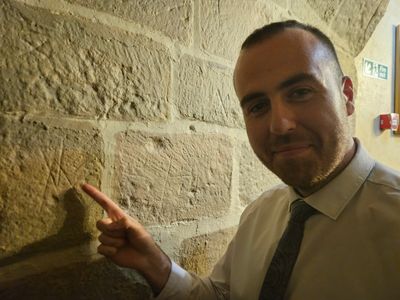
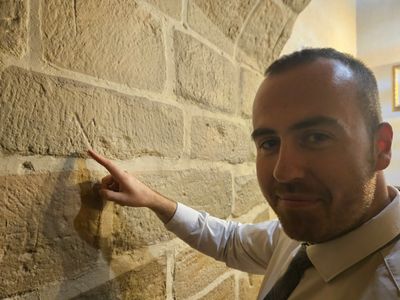
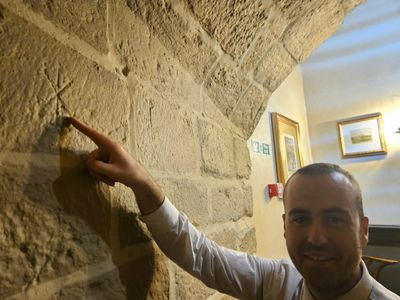
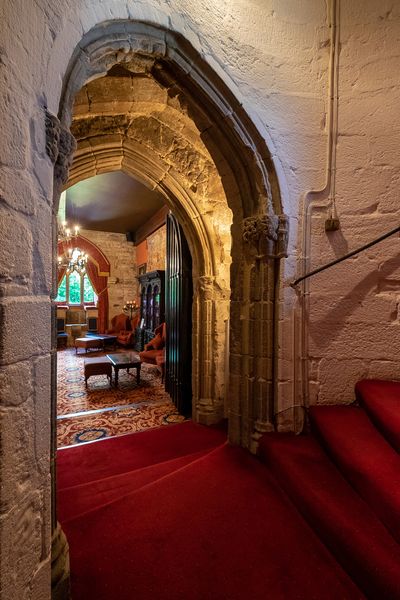
These marks were the subject of a short video that Lauren recorded for her followers. She highlighted how the marks in the corridor were a VV marking, a cross and an infinite loop. These are all common ‘witch’ marks, or apotropaic marks (apotropaios being the Green for turning away/repelling). All the markings were found on a wall close to a doorway - the usual location for witch marks.
This is because these marks have nothing to do with witchcraft but with seeking protection from evil spirits. Medieval people were highly superstitious and carved this type of marking into stone and wood, to repel or trap evil spirits and prevent bad luck besetting them. Believing spirits would arrive through entry points like doors and windows, they marked these locations with the symbols they believed would safeguard them.
In Langley Castle’s case, the markings are on walls featuring stones in the exact same place as in 1350, when the castle was built. Whilst witch marks were used from the medieval period to the 19th century, there can be little doubt those at Langley Castle are medieval. The castle’s roof was burnt in 1405, as a punishment by Henry IV, and the castle was not inhabited again until the late 19th century.
The VV marking represented the Virgin of Virgins (Virgo Virginium) for medieval people, who turned to the Virgin Mary as a symbol of safety. Lauren Moss also found a cross – another common witch mark, and a symbol representing an infinite loop. The latter was felt to trap an evil spirit, almost like an insect in a spider’s web.
Recently, a professor of architecture at Warwick University, Jennifer Alexander, has suggested many markings in historic properties are not witch marks but marks made by early stonemasonry apprentices, practising their skills with compasses and other tools. This would not appear to be the case at Langley Castle, given the designs Lauren spotted and their doorway locations. No stonemason initials, or daisy-wheel compass markings have been seen.
For the medieval de Lucy family, who lived at Langley Castle from 1350 to 1405, there was every need to secure safety where it could be elicited. The castle was built as a stronghold against the Scottish army under David Bruce, whose troops had previously burnt down the former manor house at Langley. The castle’s first owner clearly anticipated being under siege, also including 12 medieval garderobes in the castle’s design, for sanitary waste disposal. These garderobes still exist at Langley Castle and are viewed as the finest example in Europe.
The castle hotel is immensely proud of the authenticity of much of its architecture is, with many facets remaining from medieval times. Centuries of laying empty were a blessing, with no modernisation occurring from era to era.
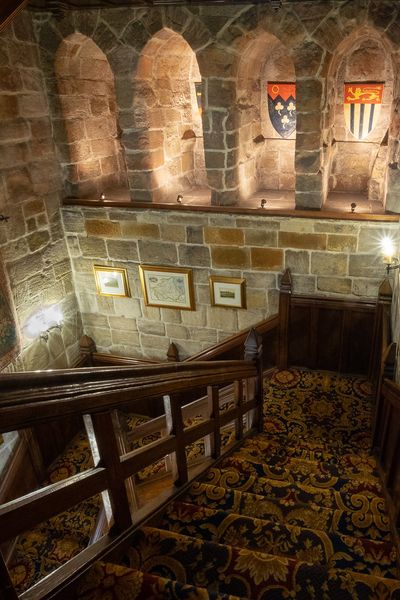
General manager Mohammed Serag says, “We were extremely interested to see Lauren Moss’s video, which helped us appreciate that we have yet another indication of our medieval past hidden in plain sight. There is so much to delight history lovers at Langley Castle, from our seven-feet-thick walls to our original medieval staircase, designed in such a way as to disadvantage sword-wielding attackers.
“Our rich history and wonderful architecture allow us to offer a rare feature at a hotel in the UK – a Daily Battlements Tour, available to guests and non-residents. Now, we have even more to point out during that tour, thanks to the revelations about the witch marks.”
Anyone wishing to find out more about Langley Castle and its history can head to www.langleycastle.co.uk or call 01434 688888.
Ends
Editors notes
Langley Castle, built in 1350, is located in Langley-on-Tyne, Northumberland and is one of the few authentic, fortified medieval castles in England. It has a rich history, with strong links to Jacobite rebellions, is located just a stone's throw from the World Heritage Site of Hadrian's Wall and boasts features including battlements, seven-feet-thick walls, window seats set into the walls and the best example of medieval garderobes in Europe. It is one of the most exquisite wedding venues in the north and also offers a wide range of options when it comes to exclusive use, with the castle being available for weddings, family celebrations, Bar Mitzvahs and Bat Mitzvahs, D&D-style events and a wide variety of corporate functions.