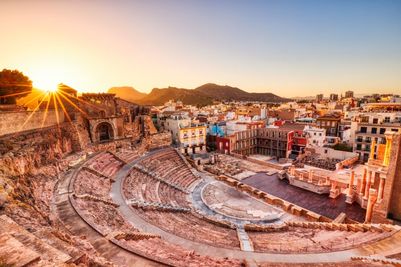
Cartagena, Spain: The Region of Murcia’s Historic Port City Still Flying Under the Radar
Published:
Read Time: 3 mins
The Region of Murcia invites UK travellers to discover a lesser-visited Mediterranean gem rich in Roman heritage, culture and coastal charm
- A welcoming Mediterranean destination offering a relaxed travel experience away from the crowds for UK visitors
- Cartagena is a city with more than 3,000 years of history, home to the Roman Theatre, forum, baths and ancient defensive walls, as well as the lively Carthaginians and Romans Festival taking place from 18–27 September 2026
- More than 300 days of sunshine each year
April 2026 – As UK travellers increasingly seek out lesser-visited destinations across Spain, the Region of Murcia is shining a spotlight on Cartagena. The historic port city remains remarkably underexplored despite offering over 3,000 years of living history, a vibrant cultural calendar and year-round sunshine.
The Region of Murcia continues to offer visitors a refreshingly uncrowded and authentic Mediterranean experience, and Cartagena is a prime example of a city where travellers can immerse themselves in local culture, history and gastronomy at a more relaxed pace.
Set around a natural harbour on Spain’s southeastern coast, Cartagena is one of the oldest continuously inhabited cities in Europe. While the Carthaginians officially founded the city in 227 BC, the area had already been home to Phoenician traders since the 8th century BC. Later conquered by the Romans in 209 BC and transformed into Carthago Nova, Cartagena quickly became one of the most important settlements in Hispania. Today, its rich past is woven throughout the city itself rather than confined to museums alone.
At the heart of Cartagena lies its beautifully restored Roman Theatre, one of Spain’s most impressive archaeological sites, alongside remains of the Roman forum, baths and ancient defensive walls. Visitors can explore these landmarks within minutes, thanks to the city’s compact, walkable centre.
Beyond its history, Cartagena reveals a striking architectural identity. Calle Mayor, the city’s main thoroughfare, is lined with ornate Modernist buildings dating back to the early 20th century, reflecting a period of prosperity and cultural ambition. Combined with more than 300 days of sunshine each year, the city invites slow exploration, whether strolling its streets or dining al fresco by the sea.
Food plays a central role in the Cartagena experience. Local cuisine draws on both land and sea, with specialities such as caldero, a rich rice dish cooked in fish broth, sitting alongside fresh seafood, the ‘asiático coffee’ a local favourite made with condensed milk, and tapas and wines from nearby Designation of Origin regions including Jumilla.
Adding to its appeal, Cartagena hosts one of Spain’s most distinctive cultural events each September: the Carthaginians and Romans Festival, declared of International Tourist Interest and held from 18-27 September 2026. This lively celebration sees more than 6,000 participants take to the streets in elaborate historical costumes, recreating ancient battles and bringing the city’s past vividly to life. In 2027, the city will mark 1,800 years since the Carthaginian occupation, promising an especially significant edition of the festival.
Booking.com offers a three night stay at AC Hotel by Marriott Cartagena, opened in July 2025, from £183pp, based on two adults sharing in September 2026.
For general destination information, please visit here
-End-
About the Region of Murcia
The Region of Murcia, located in southeastern Spain, offers an authentic taste of Spanish culture, combining rich heritage with diverse natural landscapes. Bordered by both the Mediterranean Sea and the Mar Menor, Europe’s largest saltwater lagoon, the region is home to two protected marine reserves, Cabo de Palos-Islas Hormigas and Cabo Tiñoso, as well as three established wine routes with Designation of Origin status: Jumilla, Bullas and Yecla.
With over 300 days of sunshine each year, the Region of Murcia is an ideal year-round destination for outdoor living. Its coastline, known as the Costa Cálida (‘Warm Coast’), provides a wide range of experiences, from beaches and water sports to wellness and leisure activities, making it a versatile destination for all types of travellers.
Media Contact:
Jess Cochrane & Immy Hockings
Lemongrass Marketing
Email: murcia@lemongrassmarketing.com
Ends