How to pass an ESOS Environment Agency audit and not get fined
Published:
Read Time: 4 mins
By Sam Arje
ESOS fines as the warning signal
With the recently published enforcement data, it’s clear that ESOS fines are no longer a hypothetical risk. The Environment Agency has been actively penalising organisations that cannot demonstrate compliance, bringing both financial cost and reputational exposure. For many organisations, the impact goes beyond the value of the fine itself, drawing unwanted regulatory attention and raising questions about governance, oversight and internal controls.
Interestingly, these penalties are rarely the result of a failure to identify energy savings. Requests to be audited by the Environment Agency are more commonly linked to process, governance and evidence gaps; things like unclear organisational scope, incomplete data, unsubstantial reasons for data exclusions, or a lack of evidence around decisions made during delivery. In other words, organisations are being challenged not on intent, but on whether their compliance stands up to scrutiny.
This enforcement activity sends a clear signal: ESOS is no longer a low risk, light touch obligation. The Environment Agency’s audit approach is testing whether organisations can evidence compliance in full, and fines are increasingly the outcome where they cannot. ESOS compliance is now being assessed in practice, not just on paper.
What are Environment Agency audits?
Environment Agency audits are designed to test whether organisations can demonstrate their ESOS compliance. ESOS Submissions are assessed on the strength of the evidence behind them: ESOS submission auditors are looking to understand how decisions were made, what data was used, and whether those decisions can be clearly justified.
Environment Agency audits focus on rationale, traceability and defensibility. Organisations are expected to show not only what was included, but why, if it has occurred, certain assets, entities or data streams were excluded, and on what basis those decisions were taken. Where explanations are unclear, inconsistent or poorly evidenced, compliance risk increases significantly.
Importantly, many ESOS issues only surface after submission, when assumptions that may have gone unchallenged during delivery are examined in more detail. What appeared reasonable at the time can become difficult to defend under audit if supporting evidence is incomplete or decisions are not clearly documented.
The key point is that ESOS submission audits are not about intent or effort. They are about evidence and justification and whether an organisation can clearly demonstrate that its compliance approach stands up to regulatory scrutiny.
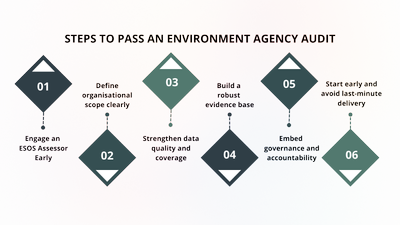
What can you do to pass an Environment Agency audit
From my experience as an ESOS Lead Assessor, these are the key things organisations should focus on when starting their ESOS journey to improve being ready for an Environment Agency audit.
• Include all UK entities within the responsible undertaking
Ensure ESOS scope correctly captures all relevant UK entities and legal structures, avoiding partial or underestimated group definitions.
• Report at the highest appropriate level of organisational structure
ESOS compliance must sit at the correct corporate level. Misalignment between legal, operational and reporting structures is a common audit trigger.
• Include all buildings, activities and energy streams within scope
Buildings, transport and industrial processes should be fully accounted for unless there is a legitimate, clearly documented reason for exclusion.
• Use energy data that is within your operational control
Data must reflect energy the organisation actually controls, rather than assumptions based on billing convenience or landlord arrangements.
• Be clear and robust where data is excluded
If certain data is excluded, there must be a solid, defensible justification, supported by evidence, not convenience or lack of availability.
• Use accurate data wherever possible – and minimise estimation
Estimated data increases audit risk. Where estimates are unavoidable, the methodology must be explained, consistent and reasonable. Estimated data should be used only as a last resort.
Passing a post submission ESOS audit is less about perfection and more about clarity, completeness and justifiable decision making.
Why many ESOS issues are still avoidable
The Environment Agency is looking at how compliance is approached in practice. Late programme starts; unclear ownership and weak internal governance are recurring factors that leave organisations exposed to scrutiny
Early engagement with an ESOS Lead Assessor and the right internal stakeholders makes a significant difference when it comes to evidencing key decision making, appointing tasks and gathering data.
When scope, data requirements and governance arrangements are clarified upfront, organisations are far better placed to avoid the assumptions and evidence gaps that often surface under audit.
ESOS as a governance test, not just an energy audit
Organisations are now well into ESOS Phase 4, aiming for the compliance deadline on 5 December 2027. However, ESOS has always been about more than identifying energy savings and meeting the deadline. ESOS is increasingly being used as a test of organisational governance and compliance maturity.
Those that treat ESOS as an ongoing compliance programme rather than a periodic reporting exercise will be far better placed to manage risk and avoid enforcement action. By getting ahead and following my key tips, organisations will be able to stand up to scrutiny with confidence.
Ends
Editors notes
About Sam Arje
Sam Arje writes as an ESOS Lead Assessor actively involved in ESOS delivery and audit preparation, bringing first‑hand insight into why organisations fail audits, and how they can avoid enforcement action.
About TEAM
TEAM is an energy and sustainability consultancy. It helps organisations with large energy estates reduce consumption and carbon emissions to save money and meet commercial and compliance targets on their journey to net zero.
Founded in 1985, it has a long history of helping customers navigate changing definitions and certification standards. TEAM Energy is an Employee Ownership Trust (EOT), with employees having a direct stake in its customers’ success.