The Missing Link in Carbon Strategy: Connecting Carbon Accounting, Reporting and Action
Published:
Read Time: 5 mins
By Tom Anderton, Commercial Director at TEAM Energy
Organisations are no longer judged on ambition alone, they are expected to demonstrate credible, measurable progress on emissions reduction. However, the confusion around the tools and systems to support this journey remains a challenge.
In our experience, one of the biggest barriers an organisation faces is understanding how carbon accounting, carbon management and carbon reporting software are often used interchangeably. In practice, they represent three distinct, yet interconnected, functions within a mature carbon strategy.
Understanding these differences is essential for organisations looking to deliver credible carbon reduction, particularly as frameworks such as SECR, the GHG Protocol and emerging UK Sustainability Reporting Standards become more embedded.
Carbon Accounting is the foundation
As a starting point, carbon accounting answers the most fundamental question “What is our carbon footprint?”
At its core, carbon accounting is about measurement and accuracy. It enables organisations to collect emissions data from across operations, including energy use, transport, procurement and waste. It also involves applying recognised emission factors, such as DEFRA conversion factors, and calculating emissions across Scope 1, 2 and 3 categories. This process helps establish a reliable baseline for reporting and target-setting, while maintaining a clear, verifiable audit trail of both data and methodology.
Without this foundation, any reporting or reduction strategy lacks credibility.
For many UK organisations, carbon accounting has moved from a voluntary exercise to a regulatory requirement, forming the basis of disclosures under frameworks such as SECR.
Carbon Reporting is about disclosure
Once emissions are measured, the next challenge is not just accuracy, but communication.
This is where carbon reporting plays a critical role and answers the question “How do we demonstrate and communicate our carbon performance?”
Reporting systems transform raw emissions data into structured, audit-ready disclosures. They support regulatory compliance such as SECR, ISO 14064 and UK SRS, as well as investor and stakeholder reporting through frameworks like CDP and TCFD-aligned disclosures. They also strengthen internal governance via dashboards and trend analysis, while enabling robust audit and assurance processes through documented methodologies and version control. As sustainability disclosures increasingly mirror financial reporting standards, the ability to produce transparent, defensible outputs is becoming essential.
In this context, reporting is not just about compliance, it is about trust, comparability and reputational risk management. But reporting alone does not reduce emissions.
Carbon Management is about taking action
Measurement and disclosure alone do not reduce emissions. Carbon management bridges the gap between insight and action, addressing the question “How do we reduce our carbon footprint and deliver on net zero commitments?”
Carbon management focuses on execution and accountability, enabling organisations to set science-based or internally aligned reduction targets. It supports the planning and tracking of decarbonisation initiatives across business functions, while also facilitating supplier engagement, particularly for complex Scope 3 emissions. It integrates emissions data into operational and procurement decisions and establishes governance structures to monitor progress and drive accountability. This is where strategy becomes operational, turning ambition into measurable outcomes.
As organisations move beyond reporting compliance towards genuine decarbonisation, this capability is becoming a key differentiator.
A connected system, not separate silos
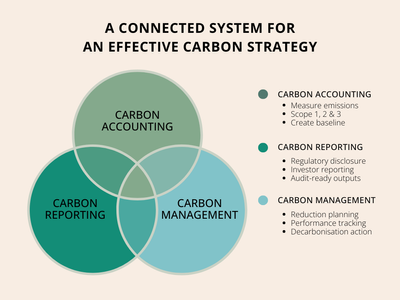
While these functions are often discussed independently, in practice they operate as a connected workflow. Carbon accounting provides the data, carbon reporting communicates the data, and carbon management uses the data to drive change. Each layer depends on the others: without accurate accounting, reporting cannot withstand scrutiny; without structured reporting, insights remain inaccessible to stakeholders; and without effective management processes, emissions data does not translate into meaningful reduction.
This interconnected model reflects how mature organisations are now structuring their carbon strategies.
Why the distinction between accounting, reporting and management is significant
Growing regulatory pressures are requiring UK organisations to align with structured disclosure frameworks such as SECR and emerging sustainability reporting standards. Recent Government announcements supporting the development of the UK Sustainability Reporting Standards represent a positive step towards greater consistency and comparability in sustainability disclosures, further reinforcing the need for robust carbon data and governance. For organisations looking to understand the significance of this shift, the move towards a more unified carbon accounting standard is expected to improve transparency and confidence in reported emissions data.
At the same time, while reporting frameworks are moving towards greater consistency, complexity remains, particularly in relation to Scope 3 emissions. Indirect value chain emissions often represent the largest share of an organisation's footprint, requiring more advanced data collection and sustained supplier engagement.
Alongside this, investors, customers and regulators increasingly want more than disclosure alone, with a growing focus on clear, measurable progress in emissions reduction.
What Should Organisations Prioritise?
Organisations refining their carbon strategy should avoid treating these functions in isolation:
Start with robust measurement
Accurate carbon accounting is the foundation for everything that follows
Ensure reporting is compliant and audit-ready
Disclosures must align with relevant frameworks and withstand external scrutiny
Embed carbon into decision-making
Management tools should connect emissions data with operational and strategic action
Crucially, organisations should avoid treating these functions as standalone methods as gaps between accounting, reporting and management create inefficiencies, duplication and risk.
From data to decarbonisation: Turning insight into impact
Aside from being a reporting challenge, transition to net zero represents a broader operational transformation. Carbon accounting, reporting and management are not competing concepts; rather, they work together as the foundation of an effective carbon strategy. Measurement provides the visibility needed to understand emissions, reporting builds the transparency required to communicate performance, and management delivers the actions that drive meaningful change.
Organisations that recognise and integrate these capabilities will be better positioned to move beyond compliance alone. By connecting data, insight and action, they can translate ambition into sustained emissions reduction and deliver real, measurable impact.
Ends
Editors notes
About TEAM
TEAM is an energy and sustainability consultancy. It helps organisations with large energy estates reduce consumption and carbon emissions to save money and meet commercial and compliance targets on their journey to net zero.
Founded in 1985, it has a long history of helping customers navigate changing definitions and certification standards. TEAM Energy is an Employee Ownership Trust (EOT), with employees having a direct stake in its customers’ success.
About Tom Anderton
A commercially astute Commercial Director, Tom brings over a decade of experience across carbon, sustainability and energy sectors, combining strategic insight with disciplined commercial leadership to drive sustainable growth, strong partnerships and a collaborative, employee focused culture.