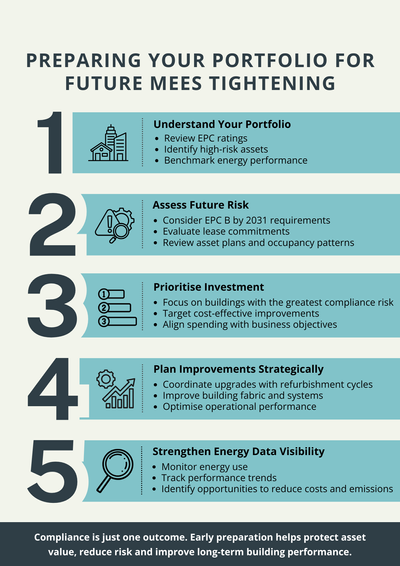
Preparing your portfolio for future MEES tightening
Published:
Read Time: 4 mins
By Alex Au Yeung, Energy Consultant, TEAM Energy
The UK Government's long-awaited update to Minimum Energy Efficiency Standards (MEES) provides greater clarity for commercial property owners and asset managers. The Government has confirmed its intention to introduce a more targeted approach, under which private rented non-domestic buildings over 1,000m² in England and Wales would be expected to achieve a minimum Energy Performance Certificate B rating by 2031, where cost-effective and subject to secondary legislation. The proposed interim EPC C milestone has been removed.
While these changes provide additional time, they should not be interpreted as a relaxation of standards. Building energy performance remains closely linked to the UK's net-zero objectives, and expectations for commercial property are likely to continue increasing over the coming years.
For organisations managing property portfolios, the challenge is not simply meeting a future compliance deadline, but making informed investment decisions that reduce risk, protect asset value and improve building performance over the long term.
What current policy signals tell us
The latest proposals reinforce EPC B by 2031 as the central policy objective for larger private rented non-domestic buildings over 1,000m² in England and Wales. Although the Government has shown flexibility on delivery timescales and scope, there is little evidence of a reduction in overall ambition for improving energy performance across the commercial property sector.
The removal of interim milestones should not be viewed as a reduction in regulatory pressure. Existing flexibility mechanisms, including the seven-year payback test and exemptions, are expected to remain, meaning only improvements that are practical, affordable and cost-effective would be required. Future policy may also place greater emphasis on operational energy performance, carbon intensity and ongoing reporting, alongside Commercial Energy Performance Certificate ratings. As 2031 approaches, compliance and enforcement are also likely to come under greater scrutiny.
In other words, the future of MEES is less about a single compliance date and more about continuous improvement expectations.
Scenario planning: preparing for multiple regulatory outcomes
With the future shape of MEES still evolving, organisations should avoid planning against a single regulatory outcome.
The most likely scenario is a gradual tightening of standards, with EPC B remaining the key milestone for larger private rented non-domestic buildings and enforcement increasing over time. However, the policy could continue to evolve, and interim thresholds or broader requirements could return in future. In this scenario, buildings rated E to G may face increasing risk if improvement plans are delayed.
A more significant shift would see greater emphasis placed on actual energy use and carbon performance alongside EPC ratings. This could lead to more detailed disclosure requirements and a stronger focus on building performance in operation, making energy data, monitoring and optimisation increasingly important.
Whatever form future regulation takes, the common theme is clear: organisations that understand their portfolio, prioritise investment and improve visibility of energy performance will be better placed to adapt.
Moving from compliance to asset strategy
As standards evolve, MEES should be considered within the wider context of asset management rather than as a standalone compliance exercise.
Effective planning begins with understanding where the greatest risks and opportunities exist. Not all assets require the same level of investment, and decisions should take account of factors such as current Commercial EPC ratings, operational performance, lease commitments, occupancy patterns and future asset plans.
Timing also matters. Aligning energy improvements with planned refurbishments and maintenance programmes can help minimise disruption, control costs and avoid rushed retrofit programmes closer to regulatory deadlines.
Achieving EPC B will typically require a combination of building fabric improvements, system upgrades and operational optimisation. Organisations developing an EPC B compliance strategy are likely to achieve better outcomes when these measures are planned as part of a wider asset management programme rather than relying on a single intervention.
At the same time, energy data is becoming increasingly important. Better monitoring and analysis can help organisations understand building performance, assess improvement pathways and identify opportunities to reduce both energy use and operating costs.
The value of early preparation
Although the regulatory framework continues to develop, the benefits of early action are already clear. A structured, long-term approach can help organisations prioritise investment, manage compliance risk and align energy performance improvements with wider business objectives.
Those that incorporate energy performance into broader asset management strategies are likely to be better positioned to respond to future changes, whatever form they take.
Future-proofing portfolios for a low-carbon market
The revised 2031 timetable changes the timeline and narrows the immediate scope, but it does not change the direction of travel. Property owners and asset managers now have an opportunity to take a more measured and strategic approach to improving building performance, particularly across larger private rented non-domestic assets that may fall within the proposed threshold.
For many organisations, the greatest risk is not acting too early but leaving decisions until regulatory requirements become more defined. Whether future policy focuses on EPC ratings, operational performance or a combination of both, the portfolios that are already investing in energy efficiency, performance data and long-term asset planning will be best placed to adapt.
Ultimately, MEES readiness is becoming less about compliance alone and more about creating portfolios that are resilient, efficient and fit for a low-carbon future.
Ends
Editors notes
About Alex Au Yeung
Alex specialises in ESOS, EPC and TM44 compliance, combining technical expertise with hands-on facilities and project management experience. His practical understanding of building operations enables him to streamline compliance processes and provide clear recommendations that support regulatory compliance and improved energy performance.
About TEAM
TEAM is an energy and sustainability consultancy. It helps organisations with large energy estates reduce consumption and carbon emissions to save money and meet commercial and compliance targets on their journey to net zero.
Founded in 1985, it has a long history of helping customers navigate changing definitions and certification standards. TEAM Energy is an Employee Ownership Trust (EOT), with employees having a direct stake in its customers’ success.