Science-Based Targets Are Growing Up: Why Validation Is Only the Beginning
Published:
Read Time: 4 mins
By Tim Holman, Head of Consultancy, TEAM Energy
For more than a decade, validation by the Science Based Targets initiative (SBTi) has been treated as a defining corporate sustainability milestone. It remains an important signal that targets are aligned with climate science. But a validated target is not evidence of decarbonisation. The real test is whether it changes investment, procurement and operational decisions.
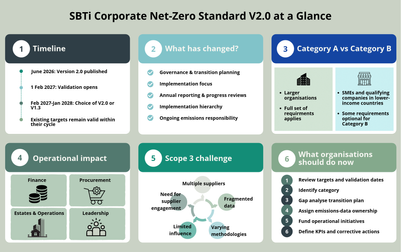
The Corporate Net-Zero Standard Version 2.0, published in June 2026, makes this direction clear. It expands the SBTi framework beyond target setting towards implementation, transparent progress reporting and continuous improvement. The next dividing line will not be between organisations with and without targets; it will be between those that treat targets as sustainability commitments and those that use them as business-management tools.
Many large organisations are now familiar with measuring emissions and setting credible climate targets. The harder task is embedding emissions reduction into the decisions that determine how a business operates: which buildings are upgraded, which vehicles are replaced, which suppliers are selected and which projects receive capital.
A target may set the destination, but it does not make those choices. Delivery depends on finance applying carbon considerations to investment appraisals, procurement using emissions criteria, estates approving retrofit programmes and operational teams owning measurable reductions. Those decisions happen throughout the organisation, often far away from the sustainability team.
Many organisations are therefore entering a more demanding phase of the net zero transition, where success depends less on setting targets and more on demonstrating delivery.
The rise of implementation accountability
Version 2.0 strengthens the link between targets, transition planning, governance, implementation and reporting. Companies are expected to pursue targets on a best-efforts basis, use the levers within their control or influence, disclose key assumptions and dependencies, and address barriers to delivery.
That best-efforts principle matters. It recognises that technology, infrastructure, suppliers and policy can constrain progress. It is not a lower bar: organisations still need to show what they did, what prevented further progress and how they responded. Credibility therefore comes from transparent management of delivery, not from claiming that every dependency is under direct control.
This changes the leadership question. Boards should not ask only, “Do we have a validated target?” They should ask where reductions will come from, who owns each intervention, how capital will be prioritised and what will happen when performance falls behind plan.
Why transition plans are becoming strategic documents
A transition plan is becoming the operating model for turning climate ambition into business action. It should connect targets to named initiatives, investment decisions, responsibilities, timescales, assumptions and dependencies.
At a minimum, it should answer four practical questions:
- Where will emissions reduction come from?
- Who is accountable for each intervention?
- How will progress be measured, assured and reported?
- What corrective action will be triggered if delivery falls behind?
Answering them requires finance, procurement, operations, estates, facilities and executive leadership to work from the same plan and data. SBTi validation checks relevant requirements; it should not be read as an endorsement of a transition plan’s overall feasibility, quality or legal compliance. Those remain management responsibilities.
Scope 3 is where credibility will be tested
Delivering Scope 3 reductions is particularly challenging because the emissions originate from a wide range of suppliers, products, services and value-chain activities.
For organisations with significant Scope 3 emissions, the obstacles are rarely measurement alone. Data ownership may be fragmented, supplier information inconsistent and procurement priorities misaligned with climate objectives. Influence also varies: a company may be able to change a specification or contract more readily than the technology or infrastructure available to a supplier.
Credible Scope 3 action therefore means translating a corporate target into category-level decisions: assigning ownership to procurement teams, improving supplier data, setting engagement priorities and being transparent about where direct influence is limited. The implementation hierarchy in Version 2.0 keeps direct reductions in operations and value chains at the top, while recognising broader activity-pool and sector-level action, and certain market instruments subject to safeguards.
From ambition to evidence
SBTi validation will remain an important signal of intent and scientific alignment. But leadership will be judged increasingly by what happens afterwards: where reductions come from, who is accountable and how underperformance is corrected. The organisations that close that gap will not simply have climate targets; they will have made decarbonisation part of how the business is run.
Ends
Editors notes
About TEAM
TEAM is an energy and sustainability consultancy. It helps organisations with large energy estates reduce consumption and carbon emissions to save money and meet commercial and compliance targets on their journey to net zero.
Founded in 1985, it has a long history of helping customers navigate changing definitions and certification standards. TEAM Energy is an Employee Ownership Trust (EOT), with employees having a direct stake in its customers’ success.
Tim Holman – Head of Consultancy, MSc, MEng, CEng, MEI
Tim directs TEAM’s consultancy practice, applying 25+ years in strategy, audits, metering, and compliance to deliver robust, audit‑ready results for customers. A Chartered Energy Engineer and Member of the Energy Institute, Tim holds an MSc in Energy Conservation and the Environment from Cranfield University and an MEng in Mechanical Engineering from the University of Salford.