The Net Zero Skills Gap: Why Technology Won’t Replace Sustainability Expertise
Published:
Read Time: 5 mins
By Tom Anderton, Commercial Director, TEAM Energy
Carbon management technology is advancing quickly. Platforms can now automate data collection, calculate emissions, maintain audit trails, forecast trajectories and support reduction planning. AI is extending these capabilities further.
That should make carbon management faster and more efficient. But greater efficiency is not the same as greater expertise.
According to the UK Parliament’s research on green skills, the net zero transition will increase demand for green skills and require both new recruits and the upskilling of the existing workforce. The research also identifies enabling skills such as project management, collaboration and digital capability alongside technical expertise.
The challenge for organisations is therefore not simply adopting better net zero software. It is ensuring they have people capable of interpreting its outputs and turning carbon data into credible operational, financial and strategic decisions.
Automation can calculate but it cannot set strategy
Carbon accounting may appear relatively straightforward: collect activity data, apply appropriate emissions factors and calculate the resulting greenhouse gas emissions.
In practice, producing a credible inventory requires decisions about organisational boundaries, data sources, methodologies, assumptions, exclusions and quality controls. The GHG Protocol describes emissions calculation as a multi-step process and states that an accurate and useful inventory requires careful attention to activity data and quality control before emissions are estimated.
Technology can make that process significantly more efficient, but the quality of the inventory still depends on the decisions behind it.
A year-on-year fall in emissions, for example, could result from an energy efficiency programme. Equally, it could reflect an asset disposal, different operating conditions or a change in data coverage. The calculation identifies the movement; professional interpretation establishes its significance.
That distinction matters because carbon data increasingly informs decisions beyond sustainability reporting.
From carbon data to management information
A carbon footprint should be viewed as management information, not simply a reporting output.
Identifying an emissions hotspot does not explain its cause or determine the appropriate response. An increase in building emissions could relate to equipment performance, occupancy or operating patterns. A change in Scope 3 emissions could reflect changes in purchasing or improvements to the methodology and underlying data.
Specialists therefore need to test whether information is complete and comparable, understand changes to reporting boundaries or methodologies, and determine whether the evidence is sufficiently robust to underpin investment decisions or external reporting.
Carbon potential must translate into commercial reality
The same principle applies to decarbonisation planning.
Software can help identify reduction opportunities and model interventions, from building controls and energy efficiency measures to electrification and renewable generation. But identifying what is technically possible is not the same as establishing what is commercially viable.
Capital availability, asset condition, lease arrangements, infrastructure constraints, operational requirements and investment criteria can all affect whether, and when, an intervention should proceed.
This is where sustainability professionals and net zero consultants increasingly need to connect carbon reduction with financial and operational decision-making.
A credible transition plan should not simply present a list of potential carbon savings. It should establish priorities, dependencies, investment requirements and realistic implementation timescales.
That demands expertise extending beyond carbon calculation.
Sustainability expertise is becoming more cross-functional
The skills required to deliver net zero are broadening because responsibility does not sit within one department.
Estates teams understand buildings and infrastructure. Procurement has influence over supply chains. Finance assesses investment and risk. Sustainability teams bring carbon expertise and environmental objectives, while senior leaders must balance these considerations against wider organisational priorities.
Increasingly, the role of the sustainability professional is to connect these perspectives. That requires not only carbon and data literacy, but commercial awareness, stakeholder management and an understanding of governance and investment processes.
The scale of the wider skills challenge is already recognised nationally. A UK Parliament briefing notes that around 80% of the workforce expected to be working in 2030 is already in employment, making upskilling an important part of the transition. More recently, Skills England identified STEM, skilled trades and managerial roles among the occupations and capabilities in demand across clean energy industries.
For organisations, this suggests the priority should not be technology investment in isolation. Technology capability and workforce capability need to advance together.
AI changes the work, not the accountability
AI is likely to accelerate that shift.
It can support data classification, anomaly detection, forecasting and scenario analysis, reducing the time specialists spend processing information and enabling greater focus on performance and action.
Recent research published by Oxford Academic explores the potential for AI to support resource and energy efficiency, innovation, skills development and training, while also recognising concerns about potential deskilling and job displacement.
For carbon management, that creates an important governance consideration.
AI-generated analysis is still dependent on the quality of the source information and the methodology and assumptions applied to it. An authoritative-looking forecast does not remove uncertainty from inadequate data.
Organisations therefore need to maintain clear accountability. Someone must understand how important outputs were produced, challenge unusual results and determine whether recommendations are appropriate before they become investment decisions, targets or external claims.
An audit trail can show how a figure was generated. It cannot take responsibility for the decision made from it.
Technology should strengthen expertise
The future of carbon management should not be framed as people versus technology.
Software and AI will increasingly take on routine analytical work, giving sustainability professionals more capacity to focus on performance, strategy and implementation.
But the strategic questions remain human ones: what does the data mean, how reliable is it, which interventions are viable and what should the organisation prioritise?
Closing the net zero skills gap therefore means developing professionals who can use increasingly sophisticated technology without outsourcing judgement to it.
AI will change how carbon management is delivered. The organisations that benefit most will be those that use technology to amplify expertise, not replace it.
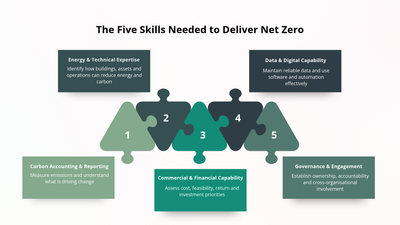
For organisations considering whether they have the right capabilities in place, TEAM Energy’s guidance on the skills and expertise needed to deliver Net Zero explores the key areas to consider and how capability gaps can be addressed.
Ends
Editors notes
About TEAM
TEAM is an energy and sustainability consultancy. It helps organisations with large energy estates reduce consumption and carbon emissions to save money and meet commercial and compliance targets on their journey to net zero.
Founded in 1985, it has a long history of helping customers navigate changing definitions and certification standards. TEAM Energy is an Employee Ownership Trust (EOT), with employees having a direct stake in its customers’ success.
About Tom Anderton
A commercially astute Commercial Director, Tom brings over a decade of experience across carbon, sustainability and energy sectors, combining strategic insight with disciplined commercial leadership to drive sustainable growth, strong partnerships and a collaborative, employee focused culture.